

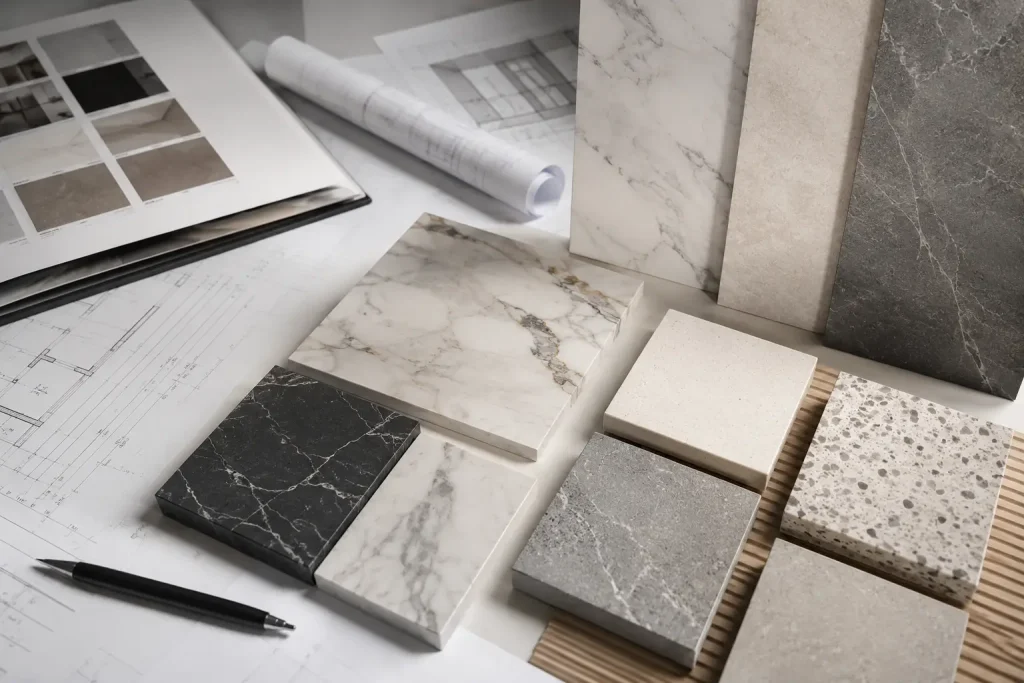
Over the last few years, the surface materials market has evolved significantly. Porcelain stoneware with marble effect, engineered quartz, solid surface materials and composite products have expanded the range of design possibilities, offering specific performance characteristics for very different applications.
This evolution has also changed the way natural marble should be evaluated. Today, the comparison can no longer be limited to aesthetics or initial cost alone. Designing means understanding how each material will perform during fabrication, installation, daily use and throughout the entire life cycle of the project.
For architects, interior designers and stone professionals, the real question is no longer which material is “better,” but which material is most appropriate for the project’s objectives. This perspective makes it possible to move beyond superficial comparisons and fully appreciate the unique qualities of natural marble.
The uniqueness of natural marble remains its greatest strength
Natural marble continues to occupy a position that is difficult to replicate when a project seeks authenticity, material depth and lasting visual value.
Every slab tells a different geological story. Variations in color, veining and internal structure are not imperfections to eliminate, but characteristics that make every installation unique.
This is why marble continues to play a central role in luxury hospitality, high-end residential projects, premium retail spaces and representative architecture, where the material itself contributes directly to the identity of the space.
Industrial materials pursue a different objective: consistency, predictability and repeatability. In many projects this represents a genuine advantage, especially when visual uniformity across large quantities or multiple production batches is essential.
The comparison should be based on the application, not on the material category
One of the most common mistakes is comparing materials that are designed to solve different problems.
A heavily used residential kitchen countertop presents completely different challenges from a hotel lobby, a ventilated façade or a monumental staircase.
From a design perspective, every material family has its own strengths.
Porcelain stoneware offers excellent performance when the project requires low water absorption, high resistance to weathering, UV stability and continuity between indoor and outdoor spaces.
Engineered quartz is frequently selected for residential kitchens and bathrooms because of its very low porosity and high visual consistency, characteristics that simplify maintenance and everyday use.
Solid surface materials stand out for their ability to create seamless surfaces, almost invisible joints, integrated washbasins and thermoformed shapes that are difficult to achieve with natural stone.
Natural marble, on the other hand, remains the preferred choice whenever the project values the material itself—its optical depth, its evolving character over time and its ability to be restored and re-polished even after decades of use.
Material behavior also changes on site
The differences become even more evident during installation.
Natural stone requires careful slab inspection, control of veining direction, batch verification and, in some cases, particular attention to moisture-sensitive behavior during installation.
On large projects, these factors have a direct impact on the final quality of the work.
Alternative materials also require specific expertise.
Large-format porcelain slabs demand precision during handling and edge processing; architectural terrazzo requires rigorous installation procedures; solid surface materials introduce manufacturing techniques that differ significantly from traditional stone fabrication.
The real distinction, therefore, is not whether one material is more complex than another, but that each requires specialized knowledge throughout the entire supply chain.
Durability and maintenance tell only part of the story
When comparing materials, maintenance is often oversimplified.
Natural marble certainly requires greater care when exposed to acidic substances and certain cleaning products. At the same time, however, it offers an advantage that many alternative materials do not: it can be restored.
A polished or professionally refinished surface can recover much of its original appearance even after years of use.
By contrast, porcelain stoneware and engineered quartz generally require less routine maintenance but are often less repairable when significant chipping or deep damage occurs.
This completely changes how the total life-cycle cost of a material should be evaluated.
For designers, the right question is not simply how easily a material stains or wears, but how effectively it can be restored over time without requiring replacement.
Sustainability also deserves a deeper evaluation
Environmental performance is often discussed through oversimplified comparisons that can easily lead to misleading conclusions.
There is no single answer that applies to every project.
For natural marble, major factors include quarry location, transportation distance, slab thickness, fabrication yield and the possibility of reusing the material at the end of its service life.
Industrial materials involve different manufacturing processes, energy consumption, resin content, recycled material percentages and product-specific environmental declarations.
For this reason, the most advanced projects increasingly rely on technical documentation such as Environmental Product Declarations (EPDs) and Life Cycle Assessments (LCAs), rather than making generic comparisons between material categories.
The best choice always starts with the project
In professional practice, the real comparison is not between natural marble and alternative materials.
It is between different project requirements.
A luxury hotel, an international flagship store, a residential kitchen, a healthcare facility and a ventilated façade all respond to entirely different design priorities.
For this reason, material selection should begin with a few essential questions:
- How will the surface actually be used?
- What level of maintenance is the client willing to accept?
- What aesthetic and emotional value should the material communicate over time?
Only after answering these questions does it become possible to identify the most appropriate solution.
This is precisely where an experienced partner makes the difference. Understanding the characteristics of different materials, recognizing their application limits and guiding the selection process objectively enables better decisions while significantly reducing project risk.
Natural marble, porcelain stoneware, engineered quartz, terrazzo and solid surface should not be viewed as direct competitors in every situation.
They are different design tools, each with clearly defined strengths, limitations and ideal applications.
Understanding these differences allows architects and designers to select the material that best supports the intended use, enhancing the project rather than forcing the project to adapt to the material.
This is why, in contemporary architecture, expertise in material selection often becomes even more valuable than the material itself.
Do you have a project and want to determine which material is truly the best fit for your application?
Contact us to evaluate technical performance, aesthetic objectives and selection criteria together, and identify the solution that best supports your project.