

When people talk about marble, they tend to focus on the surface.
Color, veining, visual impact.
But the real starting point lies much further upstream.
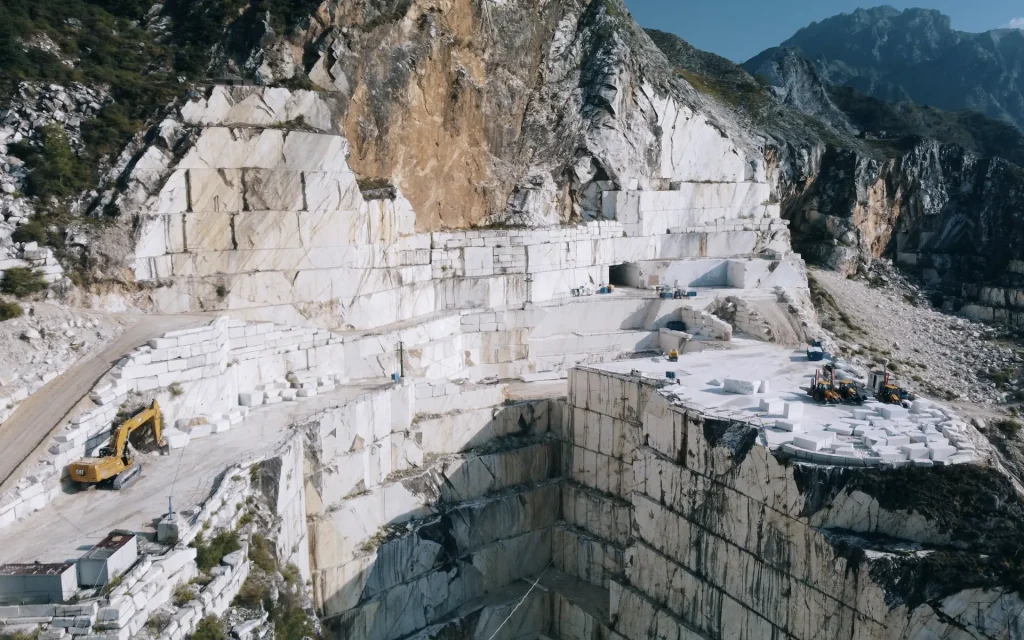
It begins in the quarry.
That is where everything originates—and, more importantly, where much of the final result is already determined.
Origin: where quality begins
Every marble has a unique geological history.
This translates into concrete characteristics: compactness, strength, internal structure, long-term stability.
Not all quarries produce the same level of material. Even within the same geographic area, there can be significant differences from one section of the quarry to another.
This means that referring simply to a “type of marble” is not enough.
What matters is where it comes from—and even more, which part of the quarry it is extracted from.
It is a level of detail that is often overlooked, yet it directly affects quality.
Extraction: from block to raw material
Marble does not originate as slabs.
It is extracted in blocks.
This stage is critical, because any mistake can compromise the material before it is even processed. The direction of the cut, the internal tensions of the stone, the presence of fractures—all play a role.
A well-extracted block maintains its integrity.
A poorly handled one may carry hidden issues that will only emerge later.
This is where a first, invisible but decisive selection takes place.
From quarry to processing
Once extracted, the block is transported to processing facilities, where it is cut into slabs.
Even at this stage, the process is not standard.
The cutting direction, for example, can completely change the appearance of the marble:
- the veining may appear more linear or more dynamic
- the pattern may become more uniform or more expressive
This is not just a technical step.
It is a design decision.
Whoever controls this phase can already shape the final result before slab selection even begins.
Selection: the real turning point
At this stage, the marble finally becomes visible.
But not everything produced is suitable for every project.
Slab selection is where the supply chain meets the project.
This is where you evaluate:
- aesthetic quality
- consistency between slabs
- compatibility with the intended application
It is also where decisions are made about what to exclude.
Because not everything that is technically acceptable is right for the project.
Careful selection is what transforms a natural material into a controlled result.
Logistics and delivery: the invisible phase
After selection, logistics come into play.
Transport, packaging, and timing management are less visible aspects, but essential to preserving the material and ensuring the project runs smoothly.
A perfectly selected slab can lose value if it is damaged or mishandled in the final stages.
For this reason, the supply chain does not end with selection.
It continues all the way to delivery on site.
Why the supply chain makes the difference
Looking at marble only at the moment of selection is limiting.
The final result is the sum of all stages:
- origin in the quarry
- quality of extraction
- processing method
- slab selection
- logistics management
If even one of these steps is not under control, the risk increases.
On the other hand, when the entire supply chain is managed consistently, marble retains its value throughout the process.
Understanding how the marble supply chain works means changing perspective.
It is no longer just about choosing a slab, but about understanding everything behind it.
Because that is where quality is built.
Marble does not begin when you see it.
It begins much earlier.
Want to access materials selected directly at the source, with full control over the entire supply chain?
Contact us to discuss your project.