

In marble, the finish affects far more than aesthetics.
It influences the perception of the surface, maintenance requirements, safety in use, and even the way the material will age over time.
For this reason, the choice of finish should never be approached only from a visual perspective. A surface that works perfectly in a private lobby may become problematic on an outdoor staircase or on a heavily used kitchen countertop.
In everyday project work, the variables that truly matter are almost always the same: exposure to water, chemical aggression, wear, ease of cleaning and the level of maintenance the client is willing to accept.
Polished and mirror polished: visual depth and maximum reflection
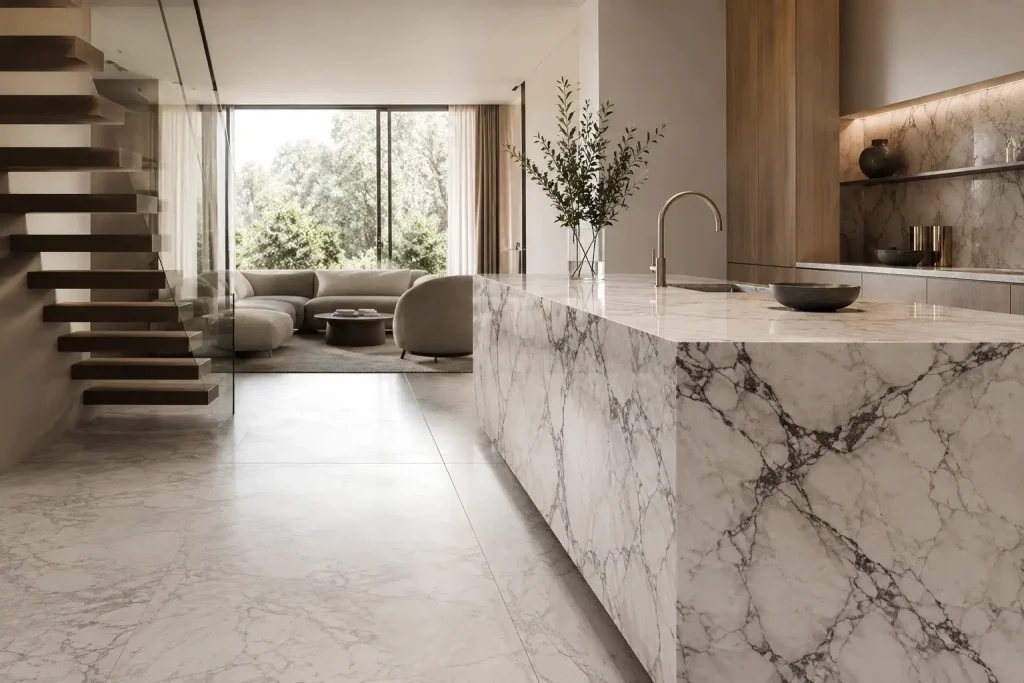
Polished marble remains the finish with the strongest visual impact. Color depth increases, veining gains contrast, and the surface reflects light very intensely.
In representative environments, it still delivers a level of visual richness that is difficult to replace, especially on materials with dramatic movement and strong graphic character.
From a technical perspective, however, polished finishes require greater awareness. Water increases the perception of slipperiness, while etching caused by acidic substances tends to become immediately visible, particularly on light calcareous marbles. Lemon, wine, aggressive cleaners or acidic cosmetics can leave dull marks on the surface. This is not related to poor material quality, but to the natural composition of the stone itself.
For this reason, polished finishes generally perform best on:
- walls
- bathroom vanities
- environments with low exposure to water and abrasion
- furniture and decorative surfaces
Kitchen countertops, on the other hand, require a more careful evaluation, especially regarding how much visible wear the client is willing to accept over time.
Honed, satin and brushed: the most balanced finishes
In recent years, many contemporary projects have shifted toward less reflective and more tactile surfaces.
Honed finishes preserve a good readability of the material while reducing direct reflection. Satin and brushed finishes introduce a softer tactile quality, often perceived as more natural and contemporary.
From an operational standpoint, these finishes are particularly interesting because they tend to make the following less visible:
- micro-scratches
- fingerprints
- small chemical etching marks
- signs of daily use
This is one of the reasons they are frequently chosen for kitchens, bathrooms, residential flooring and interior contract projects.
Even here, however, the degree of surface texture matters. Some deeply brushed finishes tend to retain dirt and residues more easily, especially in high-traffic environments or in areas exposed to hard water.
Bush-hammered, sandblasted and flamed: the real issue is performance
In outdoor applications, finish selection becomes far more technical.
Bush-hammered, sandblasted and flamed finishes are primarily used to increase grip and improve performance in wet conditions.
What is interesting is that visual roughness does not automatically correspond to actual safety. In more advanced projects, the issue is now addressed through specific performance testing on the finished surface itself, particularly in public or hospitality environments. UNI EN 16165 and EN 14231 are among the most commonly referenced standards for slip resistance testing.
Flamed and flamed-brushed finishes remain especially effective for:
- outdoor stairs
- walkways
- pool edges
- surfaces exposed to frequent water contact
However, performance varies significantly depending on the stone type. Not all marbles react to thermal shock in the same way, which is why testing on the actual material remains essential.
Treatments do not replace the right finish
One of the most common misconceptions concerns sealers and protective treatments.
A high-quality stain-resistant impregnator significantly improves resistance to staining, but it does not make marble resistant to acids.
This is particularly important in kitchens and bathrooms, where the role of protective treatments is often overestimated.
Operational reality is simpler: treatments help maintenance and slow absorption, but the chemical sensitivity of the stone remains unchanged.
For this reason, in many everyday applications, the real difference is not between “protected” and “unprotected,” but between a finish that makes wear highly visible and one that integrates it more naturally over time.
The right finish always depends on context
In real-world projects, there is rarely a universally “best” finish.
What exists instead is a more coherent balance between:
- actual application
- aesthetic expectations
- planned maintenance
- material behavior
This is also why mock-ups are becoming increasingly important in high-end projects. It is no longer enough to look at a small sample. The actual stone, with the final finish, intended treatment and—when required—relevant performance certification, should be evaluated together.
In marble, much of the final quality depends precisely on these seemingly invisible details.
Do you need help evaluating the most suitable finish based on the real use of the material?
Contact us to discuss your project and select the surfaces best aligned with the final application.