


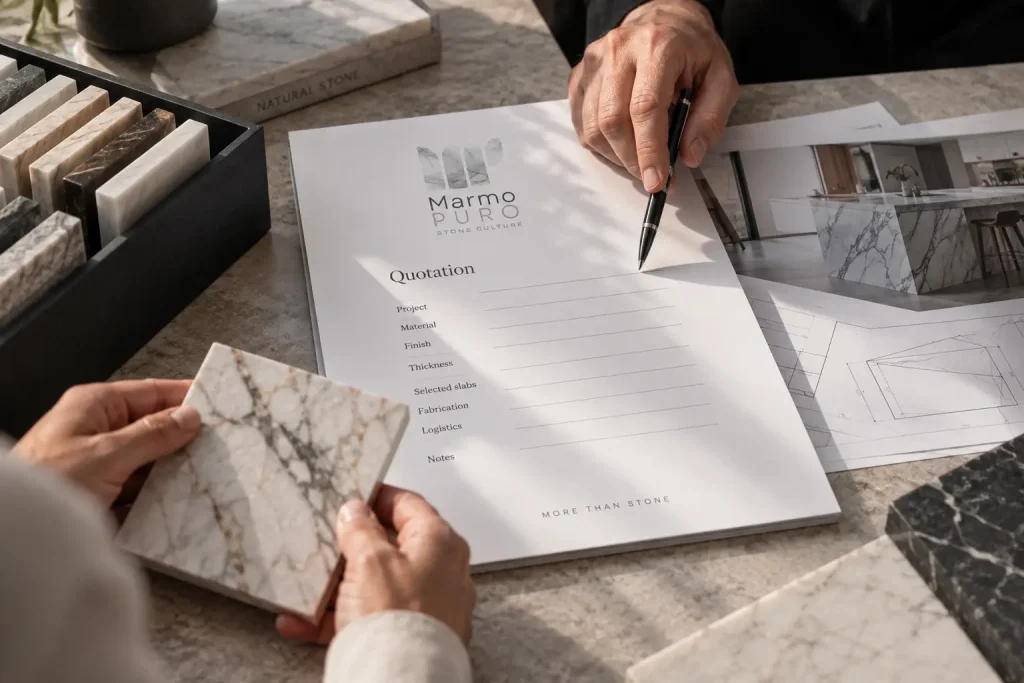
When we receive a request for a quote for marble slabs, it often starts with three pieces of information: material, quantity and thickness. These are essential, but to prepare a quote that is genuinely useful for a project, we usually need to go a little further.
Buying 30 m² of marble and needing 30 m² of finished surface are two different things. In the same way, comparing two prices per square metre may mean very little if those figures refer to different slabs, selections, yields and fabrication requirements.
At Marmo Puro, we therefore prefer to approach the quotation as part of the project itself: first we define exactly what is needed, then we identify the right material and calculate the cost based on the actual supply.
The name of the marble is only the starting point
“Calacatta 2 cm” or “Bianco Carrara 3 cm” identify a family of materials and a thickness, but they still leave several variables open.
Anyone who works with natural stone every day knows this well: under the same commercial name there can be differences in background colour, veining, structure and physical characteristics. Origin, quarry, block and, when it comes to the actual selection, the batch and individual slabs all make a difference.
The same applies to dimensions. There is no universal commercial slab size that applies to every marble: available dimensions depend on the block and the production process. This becomes particularly important when a project includes kitchen islands, tables, large panels, full-height walls or other elements where the usable dimensions of the slab directly affect the layout.
That is why, before preparing a quote, we want to understand what that slab will eventually become.
Before preparing a quote, we look at the project
If a cut list, shop drawing or even an initial definition of the main dimensions is already available, the quotation can be considerably more accurate.
Think of a marble kitchen island with one large element. Knowing that the project requires a total of 8 m² tells us relatively little; knowing that the countertop has to be cut as a single piece to specific dimensions immediately changes the search for the right material.
The same applies to walls requiring vein continuity or bookmatched compositions. In these cases, we are not simply looking for sufficient surface area: we are looking for slabs that are compatible with one another and with the architect’s intended design.
At Marmo Puro, this is one of the stages where we prefer to work directly with architects and stone fabricators. Understanding critical dimensions, piece orientation and the desired aesthetic result from the outset allows us to narrow the selection down to the slabs that genuinely make sense for the project.
Yield matters more than a “standard waste percentage”
In marble projects, waste percentages are often discussed as a standard parameter. In practice, however, applying the same percentage to every project can oversimplify the issue: there is no universal waste factor that works for every marble and every fabrication process.
The quantity that needs to be purchased depends on how the individual pieces can be positioned on the slabs actually available.
A vein that needs to continue across several elements, an area of the slab that cannot be used, a large piece that can only be obtained from a specific section, or a bookmatched composition can all reduce yield. In other projects, simpler geometries and greater aesthetic freedom allow the material to be used much more efficiently.
For this reason, when the project requires it, it makes more sense to work with nesting on the selected slabs than to automatically add a fixed percentage to the net square metres.
There is also an important economic consequence: a slab with a higher price per square metre can ultimately be more cost-effective if it provides a better yield.
The price per m² alone can be misleading
Two quotations show prices of €150 and €165/m² respectively. At first glance, the first appears to be the better deal.
But what surface area is being charged? What are the slab dimensions? How much of the material will actually be usable? Are resin treatment, mesh backing or other processes included? How much material will need to be purchased to obtain the finished pieces?
Consider a purely hypothetical example: at otherwise identical conditions, a material costing €150/m² with a 70% yield results in a theoretical raw-material cost of approximately €214 per net m². A material costing €165/m² with an 85% yield comes to approximately €194 per net m². These figures are illustrative rather than market prices, but they clearly demonstrate the principle.
For anyone managing a project budget, this is the figure that really matters: how much it costs to achieve the required result, rather than simply how much one gross square metre of stone costs.
The slab needs to be seen, especially when the veining defines the project
A sample remains useful for assessing colour, finish and certain characteristics of the material, but it cannot tell the story of an entire slab.
When the natural pattern of the stone becomes part of the architecture, we want to see the actual material: the distribution of the veins, quieter and more expressive areas, colour variations, possible cavities, filled areas, resin treatments and other characteristics that may influence the selection.
For vein matching, bookmatching or complex sequences, it is useful to identify the bundle, individual slab numbers and corresponding images, maintaining this traceability throughout the subsequent stages.
At Marmo Puro, when aesthetics are a key part of the project, selection becomes an integral part of our work. A vein may look magnificent across the full slab but fall in exactly the wrong position for a cut-out. Conversely, an apparently secondary area may be ideal for creating continuity between two elements.
These decisions only make sense when the slab and the project are considered side by side.
Resin treatment, mesh backing and repairs: better to know in advance
On some marbles, resins and backing meshes are a normal part of the slab consolidation process. Their presence does not automatically define the quality of the material, but it should be known.
For the person who will eventually fabricate the stone, understanding how a slab has been treated can be just as important as knowing its thickness.
The same applies to fissures, cavities, filled areas and natural variations. Not everything that visually interrupts the surface is necessarily a defect, just as not every discontinuity can simply be dismissed as a natural characteristic. It needs to be assessed in relation to the material and, above all, to what that slab is intended to become.
Technical characteristics should be considered according to the application
When marble becomes part of an architectural project, simply referring to a “certified material” only goes so far.
A high-traffic floor, a staircase, vertical cladding and an exterior surface all require different assessments. Flexural strength, abrasion resistance, water absorption, freeze-thaw behaviour and slip resistance become relevant according to the specific application.
Some properties that are often grouped together commercially should also remain clearly distinguished. Low water absorption, for example, does not automatically mean resistance to acids or staining. These are different properties.
For technically demanding supplies, we therefore prefer to understand the intended application first and then identify which information and performance characteristics are genuinely relevant, rather than filling the request with documents or parameters that add little value to the project.
A good quotation makes it clear what you are actually buying
Raw material, selection, cutting, CNC fabrication, holes, cut-outs, profiles, finishes, dry lay, packaging and transport can affect the final cost in very different ways.
There is no single pricing structure, but the scope must be clear. Only then is it possible to compare two quotations without treating fundamentally different supplies as equivalent.
Before confirming the purchase of marble slabs, we would therefore want to have at least the following points clear:
- material, origin and selected slabs or batch;
- usable dimensions, thickness, finish, treatments and intended application;
- cut list, required fabrication, vein management, gross quantity required and logistics conditions.
Not everything necessarily needs to be defined at the first contact. What matters is understanding which information is still missing in order to turn a generic enquiry into a properly planned supply.
Packaging and unloading are part of the quotation too
Large marble slabs are heavy. Using a density of 2,700 kg/m³ purely as an order-of-magnitude reference, a 20 mm marble surface weighs approximately 54 kg/m², while at 30 mm the figure rises to around 81 kg/m². The actual density must, of course, be verified for the specific material.
With full bundles, the total weight can quickly reach several tonnes.
The type of packaging, vehicle, total weight, equipment available at destination and responsibility for unloading are therefore not details to discuss once the truck is already on its way. They are part of the supply and should be clarified in advance.
The same approach applies to timing. Rather than referring generically to “delivery in X days”, for more complex projects it is useful to distinguish between slab availability, any required fabrication, the ready-to-load date and the expected arrival date. This ensures that the architect, stone fabricator and supplier are all working to the same timeline.
Send us the project, not just the square metres
If we had to give one practical recommendation to anyone preparing to request a quotation, it would be this: tell us what you need to create.
A drawing, a cut list, the dimensions of the main elements, some references for the desired aesthetic result and information about the intended application allow us to work far more effectively than a simple request for a price per square metre.
From there, we can discuss availability, identify the most suitable marble slabs, evaluate yield and determine together where investing in selection makes sense and where there may be opportunities to optimise the material.
This is how we prefer to work at Marmo Puro: starting from the actual stone and the actual project, so that the quotation clearly reflects what is being purchased.
Do you have a project in the planning stage? Send us your drawings, quantities and the material you are considering. With Marmo Puro, you can speak directly with natural stone professionals who can help you identify the most suitable selection before proceeding with your purchase.