

When it comes to custom marble cutting, it is easy to focus on the machine: axis precision, CNC technology, waterjet systems, diamond blades. These are important aspects, but for those who work with natural stone every day, the real issue lies elsewhere: the quality of the finished piece depends on the interaction between the material, the project and the way the fabrication process is planned.
Even an extremely precise machine can produce an element outside tolerance, an edge that requires more finishing than expected or, in the worst case, a compromised piece. A slightly warped slab, a critical vein intersected in the wrong place, a worn tool or inadequate support can be enough to affect the result.
This is where experience with marble continues to play a decisive role, even in the most advanced production facilities.
Reading the slab comes before cutting
Two slabs of the same marble, with the same thickness and from the same supply, can behave differently during fabrication. Texture, crystal size, vein orientation, microfractures, stylolites, filling, resin treatment and backing mesh all have a tangible influence on the cutting process.
This is why, at Marmo Puro, when we assess a slab intended for a specific project, we already try to read it in terms of what it will eventually become. A strong vein may be exactly what the architect is looking for aesthetically, but we also need to understand where a hole, internal corner, narrow section or joint will fall.
Orientation matters as well. Marble can exhibit anisotropic behaviour: its mechanical response may vary depending on the direction of fabrication in relation to its texture. In practical terms, two apparently equivalent cuts on the same slab may behave differently.
This is one of the reasons why, on more demanding projects, slab selection and cutting strategy should be considered together, before the file is sent into production.
Machine precision and finished-piece precision are two different things
In the dialogue between designer and fabricator, one factor deserves particular attention: tolerance.
Modern CNC and waterjet machines can achieve extremely high positioning accuracy. However, that figure describes machine performance under specific conditions; it cannot automatically be transferred to the final dimensions of a marble element.
The result is also influenced by kerf, tool wear, blade or cutter deflection, waterjet taper, slab flatness, stability during machining and subsequent finishing.
For a properly planned project, three pieces of information should therefore be clearly distinguished:
- the nominal dimension specified in the drawing;
- the permitted tolerance on the finished piece;
- the machining allowance required for calibration, rectification, profiling or polishing.
It may seem like a simple distinction, but it prevents many problems. If an edge is going to be polished, for example, specifying the same dimension for the rough-cut piece and the finished element without considering the material removed during subsequent operations means setting up the process incorrectly from the start.
Blade, waterjet or CNC? It depends on what the marble needs to become
The most appropriate technology changes according to geometry and material.
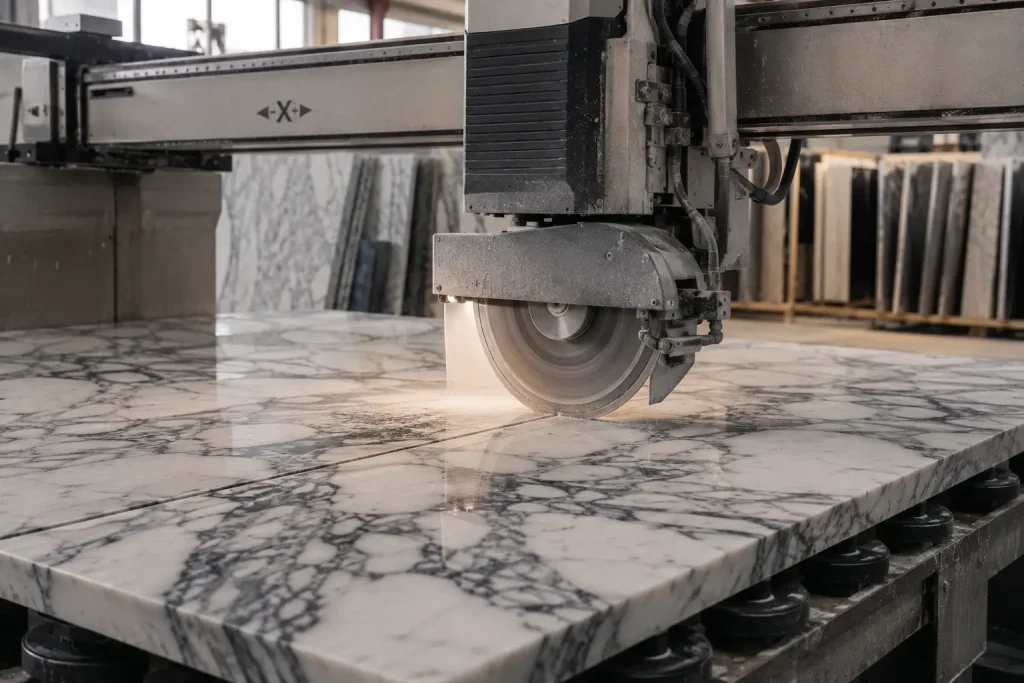
For long straight cuts, diagonals, inclined cuts and repetitive production, a diamond blade on a bridge saw remains highly efficient. When tight curves, inlays, holes, complex shapes or particularly delicate slabs are involved, waterjet cutting offers significant advantages thanks to its narrow kerf and low lateral forces. CNC cutters and grinding tools, on the other hand, are used for contouring, recesses, channels and, above all, edge processing.
For complex elements, the most effective solution is often a combination of processes. Consider a marble countertop with an undermount sink: the blade can quickly cut the straight perimeter, the waterjet can handle internal corners and complex geometries, while CNC machining can manage contouring and edge finishing. Sawjet machines were developed precisely to combine blade cutting and abrasive waterjet technology within the same production process.
The decision should therefore begin with the required geometry, the characteristics of the slab, the finish and the acceptable level of risk—not simply with the technology available.
When working on a unique piece cut from a rare slab, for example, a few additional minutes of machining matter far less than the risk of having to replace the material.
A vein can change the entire cutting strategy
CAD/CAM programming now provides highly sophisticated control over fabrication, but the digital file must incorporate a genuine understanding of the slab.
Calibrated photography or digital scanning makes it possible to position individual elements on the surface, correctly orient the veins, avoid specific discontinuities and create coherent visual relationships between pieces. This becomes particularly important for continuous cladding, bookmatched compositions and any application where the veining needs to flow visually across multiple elements.
At Marmo Puro, we consider one principle particularly important: optimising a slab does not simply mean obtaining the highest possible number of pieces from it. The goal is to find the right balance between material yield, aesthetic quality and fabrication safety.
Moving a shape by just a few centimetres can change the composition of the vein, but it can also prevent the corner of a sink cut-out or a hole from falling directly on a structural discontinuity. It is a small adjustment on screen that can make a significant difference to the finished piece.
The edge reveals how the cut was made
Anyone who works with marble can see it immediately. Chipping, striations, waviness, microfractures and progressive dimensional variations are signs of the fabrication process, not merely aesthetic imperfections.
Chipping on the underside may be related to inadequate support or tool exit; an out-of-square edge may indicate blade deflection or runout; with waterjet cutting, pronounced striations in the lower section can be associated with excessive feed rate or wear of the focusing tube. A dimension that progressively changes throughout a production run may also reveal radial cutter wear.
This is why the first piece in a production run is particularly important. It is the opportunity to verify critical dimensions, squareness, vein behaviour, edge quality and tool response before replicating the process.
In series production, the challenge changes: what was correct on the first element must remain correct on the twentieth or eightieth. Tool-wear monitoring therefore becomes an integral part of dimensional accuracy.
Even the way the slab is supported affects the result
Another aspect that is often invisible from the designer’s desk is how the piece is supported during fabrication.
A slab may be correctly positioned and still become unstable as cutting progresses. As structural sections are progressively removed, stiffness, mass distribution and the behaviour of offcuts change. Narrow sections around sink cut-outs, long slender elements and holes close to edges all require specific attention.
The same applies to resin-treated slabs, mesh-backed materials or stones with open veining. Bridges, tabs, suction cups, sacrificial panels and toolpath sequencing are just as much a part of the fabrication process as the cutting tool itself.
A significant part of the final quality is determined by precisely these less visible decisions.
Cutting with the final finish already in mind
An element intended to have a polished edge requires a different approach from a piece with a concealed rough edge. The same applies to a 45-degree mitre joint, an inlay, a tap hole or the internal profile of a sink.
The cutting process must leave enough material for subsequent finishing to remove deeper machining marks without introducing unnecessary working time or excessive material removal.
Insufficient machining allowance can leave traces of the previous process; excessive allowance increases production time, tool consumption and stress on the material.
This is also important in the relationship between designer, supplier and stone fabricator: defining the finish in advance makes it possible to establish the correct starting dimensions and fabrication sequence required to reach the final specification.
In custom fabrication, the real cost is often the cost of an error
Machine time is only one component of fabrication costs. Site measurement, CAD/CAM preparation, handling, setup, tooling, finishing and inspection all contribute—as does, above all, the risk of reworking or scrapping a piece.
The difference becomes particularly clear when working with a slab selected specifically for a project. If one element is compromised, the problem may extend far beyond the cost of that single piece: it may become necessary to find a compatible slab, recreate the vein matching, reschedule production or modify elements that have already been fabricated.
For this reason, at Marmo Puro, we prefer to approach the most delicate fabrication work by considering the material and the project together. Understanding the stone’s intended use, the genuinely critical dimensions, the finishes and the relationships between adjoining pieces allows us to identify the areas that require particular attention before production begins.
It is an approach that comes from direct experience with natural stone: first understand what needs to be achieved, then determine the best way to obtain it from the slab.
From drawing to stone, there is always an element of interpretation
Custom marble cutting has reached levels of automation and precision that would have been unthinkable only a few years ago. Yet marble continues to remind us that a CAD file describes a geometry, while a slab is a natural material with its own structure and history.
The best results are achieved when these two worlds are brought together: slab selection, vein assessment, cutting design, technology selection, process control and finishing should all be treated as stages of the same fabrication process.
For architects, designers, manufacturers and stone professionals, this means greater design freedom, but above all greater awareness. For Marmo Puro, it means putting our knowledge of the material at the service of the project, combining stone selection with a practical assessment of what that slab will ultimately need to become.
Do you have a custom marble project?
When geometry, veining, finishes and tolerances all need to work together within the same element, discussing the material before fabrication begins can prevent decisions that are difficult or costly to correct later.
Tell us about your project. The Marmo Puro team can support you in selecting the slabs and evaluating the most appropriate solutions for the result you want to achieve.
Contact Marmo Puro and speak directly with our professionals: we bring over 30 years of experience.